Project First Paycheque
Project First Paycheque
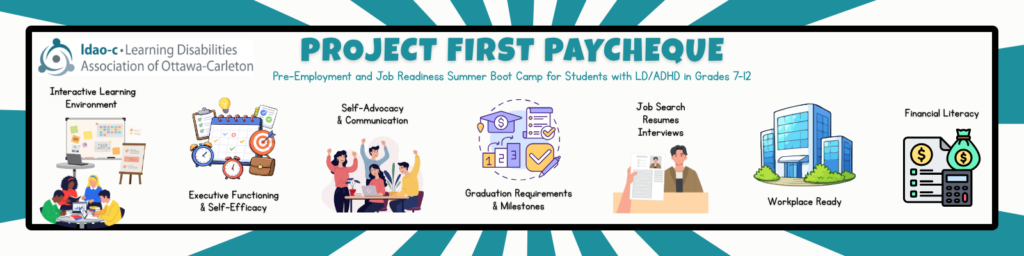
Pre-Employment and Job Readiness Summer Boot Camp for Students with LD/ADHD in Grades 7-12
Project First Paycheque
Kickstart your Future this Summer!
Project First Paycheque is a specialized, interactive morning program designed for teens (grades 7-12) who are ready to explore the foundational skills of workplace readiness.
Through engaging workshops and workplace simulations in low-ration coaching cohorts, we focus on helping teens with learning disabilities (LD) and/or ADHD build the essential soft and hard skills required for first-time job seekers.
We focus on empowering teens to confidently step into the workforce, achieve graduation milestones, and build a path toward earning their very first paycheque.
Questions?
Contact our team by email at firstpaycheque@ldaottawa.com for assistance.
Fees & Pricing
$350.00 per participant,
per weekly session
Register Now!
1. Complete the Project First Paycheque online registration form.
2. Speak with our Program Coordinator for the mandatory intake meeting to coordinate the best support for your teen.
3. Receive formal cohort aceptance and your invoice via email to finalize registration.
Program Schedule and Daily Highlights - Summer 2026
Project First Paycheque runs as a half-day morning program from 9:00 am to 12:30 pm at our LDAO-C Learning Centre, conveniently located in Emerald Plaza featuring free parking and accessible by public transit routes.
The curriculum is split into two separate, self-contained 1-week modules. With our unique, alternating week structure, families have the flexibility to register in both weeks back-to-back, or split them up across July and August to best fit your summer plans.
Week A: Landing the Job
- July 6-10, 2026
- July 20-24, 2026
- August 10-14, 2026
By the end of this session, students will be able to:
- Identify personal strengths and distinguish between hard and soft skills using a strengths-based framework.
- Describe their specific learning profiles, increasing self-awareness regarding workplace strengths and challenges.
- Create a personalized visual mind-map (“My Blueprint”) outlining the specific workplace tools, environments, and accommodations they need to thrive.
By the end of this session, students will be able to:
- Deconstruct local job and volunteer postings to identify mandatory requirements (“must-haves”) vs. optional assets (“nice-to-haves”) without feeling overwhelmed.
- Evaluate potential neurodivergent roadblocks (such as sensory overload) within specific entry-level roles and script a self-advocacy “positive pivot” or accommodation request.
- Map out a realistic summer calendar to align employment or volunteer goals with the mandatory 40 High School Community Involvement Hours.
By the end of this session, students will be able to:
- Translate non-traditional life experience (chores, hobbies, school projects, extra-curriculars) into professional, action-oriented resume bullet points.
- Draft a clean, professional 1-page resume using an entry-level structure and template.
- Build a reference request directory, identifying 2–3 professional references and drafting a formal email or text message to request permission.
By the end of this session, students will be able to:
- Navigate physical and digital application portals (e.g., Workday) successfully by executing an administrative audit to avoid common inattention errors.
- Demonstrate professional outreach communication, including professional email etiquette, digital boundary management, and application follow-up strategies.
- Draft a tailored “expression of interest” email to a coordinator or hiring manager.
By the end of this session, students will be able to:
- Recognize professional interview “green flags” regarding body language, professional attire, and executive presentation.
- Apply the STAR method (Situation, Task, Action, Result) to structure interview responses and prevent rambling.
- Formulate responses to real entry-level interview questions under low-stakes, simulated conditions while practicing personal anxiety-regulation strategies.
Week B: On-the-Job Success
- July 13-17, 2026
- July 27-31, 2026
- August 17-21, 2026
By the end of this session, students will be able to:
- Decode the “hidden curriculum” of entry-level workplaces, including breakroom boundaries, navigating downtime, and professional punctuality.
- Identify and model appropriate workplace socialization and professional attire by evaluating common social and executive errors.
- Build a personalized “Strategy Toolbox” linking common executive functioning roadblocks (like working memory lapses) to adaptive workplace tools like visual checklists and pre-scheduled alarms.
By the end of this session, students will be able to:
- Understand basic Ontario employment standards, legal worker rights, and an employer’s legal obligation to provide reasonable accommodations.
- Formulate a personalized “Three-Sentence Accommodation Script” to confidently request micro-modifications (e.g., written instructions instead of verbal chains) from a shift manager without shame.
- Evaluate and categorize real-world workplace scenarios into safety zones (Green, Yellow, Red) using a boundary stoplight system to practice safely saying “no” to unsafe or illegal requests.
By the end of this session, students will be able to:
- Apply executive functioning strategies on shift to combat working memory burnout, under-stimulation, task boredom, and sensory overload.
- Execute multi-tasking management techniques while navigating a fast-paced, high-stimulus environment during an interactive “Rush-Hour Simulation”.
- Design a structured outreach questionnaire to conduct informational interviews with industry professionals to research desired future careers.
By the end of this session, students will be able to:
- Demonstrate customer service de-escalation techniques and conflict resolution skills when dealing with difficult customers or coworkers.
- Process and filter constructive manager feedback or performance critiques, stripping away the emotional “sting” to extract useful, actionable behavioral data.
- Manage physiological stress responses during simulated conflict scenarios (“Conflict Roulette”) to practice replying calmly to high-pressure workplace moments.
By the end of this session, students will be able to:
- Analyze and read a standard paystub, developing a core understanding of taxes, automatic deductions, direct deposits, and basic budgeting.
- Identify personal impulse spending traps (like hidden digital subscription “annual burns”) and implement strategies to manage the dopamine rush of a first paycheck.
- Map out a long-term “Career Timeline Board” connecting entry-level summer roles to future education and target adult occupations, while organizing their mandatory 40-hour high school volunteer tracking sheets.